Six under-sink water filters compared by certified contaminant claims, filter cost per year and install type, from no-drill carbon filters to our founder’s own RO system. Prices checked October 2026.
Our product recommendations are made through independent research based on certifications, specs, and real-world use, and we hands-on test select products (noted on the ones we've tested). Some links are affiliate links; if you buy, we may earn a commission at no cost to you. Read our affiliate disclaimer here.
Our Choice for Best Under-Sink Filter
Aquasana Claryum 3-Stage
- Certified for lead and PFOA/PFOS (NSF/ANSI 53)
- About $168 a year in filters

The short answer: For most kitchens, the best drinking water filtration system under the sink is the Aquasana Claryum 3-Stage (~$165). It is certified to reduce lead and PFOA/PFOS, two PFAS ("forever chemicals"), and its filters cost about $168 a year. If you can't drill a faucet hole, choose the Aquasana Claryum Direct Connect (~$125). For the lowest yearly filter cost, choose the Brondell Coral UC300 (~$144), at about $80 a year if you use up to 600 gallons (about 1.6 gallons a day). To remove fluoride or total dissolved solids (TDS), choose reverse osmosis. The Waterdrop G3P800 (~$999) gives fast tankless flow. The Brondell Circle (~$450) is the one our founder has used at home for over four years.
Before you buy: Find out what is in your water. City water systems publish an annual water quality report (EPA). A private well needs a lab test (CDC). Then pick a filter whose certification lists those contaminants by name.
| Filter | Best for | Type and install | Price | Filters per year | Check price |
|---|---|---|---|---|---|
| Aquasana Claryum 3-Stage | Best overall | Carbon, own faucet (drill a hole) | ~$165 | ~$168 | Aquasana |
| Aquasana Claryum Direct Connect | Best no-drill | Carbon, uses your faucet | ~$125 | ~$184 | Aquasana |
| Brondell Coral UC300 | Lowest yearly filter cost | Carbon, own faucet (drill a hole) | ~$144 | ~$80 | Brondell |
| Waterdrop G3P800 | Best tankless RO | RO, own faucet, drain and outlet | ~$999 | ~$160 | Waterdrop |
| Brondell Circle | Best no-power RO (hands-on tested) | RO, own faucet and drain, no power | ~$450 | ~$205 | Brondell |
| Clearly Filtered 3-Stage | Lab-tested alternative | Carbon, uses your faucet | ~$550 | ~$455 | Clearly Filtered |
Prices and filter costs were checked on each maker's site on October 4, 2026, and change often.
What Each Filter Is Certified to Reduce
A ✓ means the contaminant appears on the product's certification listing. "Lab" means the maker reports a lab test, but no certifier lists the claim. "No" means neither. Clearly Filtered's and Waterdrop's arsenic claims do not say which form of arsenic was tested, and Waterdrop publishes no lab data for its lead or arsenic claims.
| Filter | Lead | PFOA/PFOS | Fluoride | Arsenic | TDS | Certifier |
|---|---|---|---|---|---|---|
| Aquasana Claryum 3-Stage | ✓ | ✓ | No | No | No | WQA |
| Aquasana Claryum Direct Connect | ✓ | ✓ | No | No | No | IAPMO |
| Brondell Coral UC300 | ✓ | ✓ | No | No | No | WQA |
| Waterdrop G3P800 | ✓ | ✓ | ✓ | Lab | ✓ | IAPMO |
| Brondell Circle | ✓ | No | ✓ | ✓ (V) | ✓ | WQA |
| Clearly Filtered 3-Stage | Lab | Lab | Lab | Lab | No | WQA (chlorine, taste and odor; lead-free materials) |
Sources, checked October 4, 2026: WQA (Aquasana), IAPMO (Direct Connect), WQA (Brondell, NSF/ANSI 53), WQA (Brondell, NSF/ANSI 58), IAPMO (Waterdrop, NSF/ANSI 58), IAPMO (Waterdrop, NSF/ANSI 53), WQA (Clearly Filtered).
How We Chose These Under-Sink Filters
Our methodology weighs evidence we could check ourselves:
- Certified claims. We searched the live listings of the three main certifiers: NSF, IAPMO and WQA. A claim counts only if it appears on the product's own listing.
- Running cost. We priced replacement filters on each maker's site (for Waterdrop, we used its published annual cost) and used the maker's own replacement schedule.
- Install and daily use. We noted whether each filter needs a drilled faucet hole, a drain line or a power outlet.
One pick is hands-on tested: our founder, Jeremiah Zac, has used the Brondell Circle at home for over four years. The other five are research-based picks. We did not test them ourselves. We fact-checked every certification, price and link on this page on October 4, 2026. If you spot an error, please contact us. To learn who we are, read more about us.
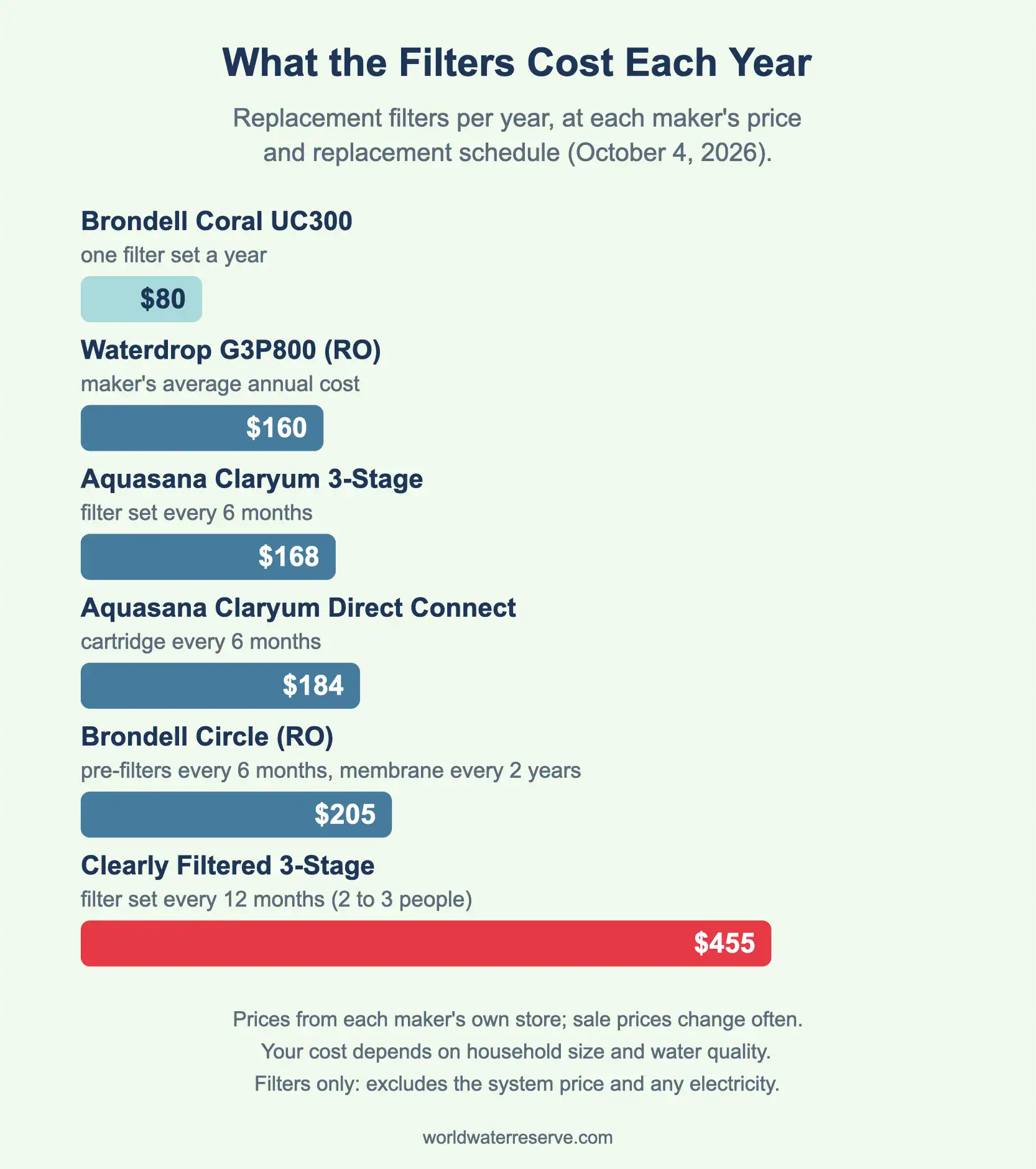
Yearly filter cost at each maker's price and replacement schedule, October 4, 2026. Clearly Filtered's cost is for a 2 to 3 person household; larger households replace it every 9 months.
The chart shows why the upfront price can mislead. The Clearly Filtered 3-Stage was lab-tested to 2,000 gallons per filter set (Clearly Filtered test data), yet its $455 set makes it the costliest to run (Clearly Filtered). The Brondell Coral's $79.99 yearly set is the cheapest, as long as you stay under its 600-gallon limit (Brondell).
The 6 Best Under-Sink Water Filters
1. Aquasana Claryum 3-Stage: Best Overall
The Aquasana Claryum 3-Stage is a carbon under-sink filter with its own faucet. WQA certifies it to NSF/ANSI 42, 53 and 401. Its NSF/ANSI 53 listing covers lead, mercury, cysts, asbestos, volatile organic compounds (VOCs), PFOA and PFOS (WQA listing). Aquasana says it reduces 78 contaminants while keeping calcium, magnesium and potassium. The current model number is AQ-6300; it uses the same filters as the older AQ-5300. It ties the Brondell Coral on certified claims. We rank it first because Aquasana publishes its flow rate and offers four faucet finishes, a no-faucet option and a higher-flow Max Flow version. If upfront and yearly cost matter more to you than flow and faucet choice, the Brondell Coral is the better buy.
- Price: ~$165 (list $349.99)
- Filters: one set every 6 months or 600 gallons, $83.99, so about $168 a year
- Flow: 0.5 gallons per minute (gpm)
- Install: dedicated faucet through a 1/2-inch hole, in four finishes, or a "no faucet" option
Pros: certified claims as broad as any carbon filter here (it ties the Brondell Coral); certified for PFOA/PFOS; keeps minerals; filters twist off.
Cons: you may need to drill a faucet hole; 0.5 gpm is slow for filling large pots; only a 1-year warranty.
Upgrade: the Claryum 3-Stage Max Flow has the same certified claims, an 800-gallon filter and 0.72 gpm flow for ~$200. It was out of stock on October 4, 2026.
Is it for you? Choose it for city water when lead or PFOA/PFOS is your concern and you can add a faucet.
2. Aquasana Claryum Direct Connect: Best No-Drill Filter

A direct-connect filter is one that fits between your cold-water valve and your existing faucet, so there is no hole to drill. The Aquasana Claryum Direct Connect is our pick in this group. IAPMO certifies it to NSF/ANSI 42, 53 and 401, including lead, cysts, VOCs, PFOA and PFOS (IAPMO listing). It is a single cartridge rated at 1.5 gpm, the fastest published flow of our carbon picks.
- Price: ~$125 (list $249.99)
- Filters: one cartridge every 6 months or 784 gallons, $91.99, so about $184 a year
- Flow: 1.5 gpm
- Install: connects to your existing faucet; no drilling
Pros: no drilling, so it suits many renters; certified for PFOA/PFOS and lead; the lowest upfront price of our picks.
Cons: every drop of cold water from your faucet runs through it, including rinse water, so filters can wear out sooner; filters cost more per year than the 3-Stage.
Is it for you? Choose it if you rent, can't drill your countertop, or want the simplest install.
3. Brondell Coral UC300: Lowest Yearly Filter Cost

The Brondell Coral UC300 is a three-stage filter: a sediment filter, a pre-carbon filter and a carbon block. WQA certifies it to NSF/ANSI 42, 53 and 401. Its NSF/ANSI 53 listing covers lead, mercury, cysts, asbestos, VOCs, PFOA and PFOS (WQA listing). Its filter set lasts 12 months or 600 gallons, whichever comes first. That is about 1.6 gallons a day; use more and you will change filters sooner.
- Price: ~$144 (list $179.99)
- Filters: one UF-35 set a year, $79.99
- Flow: not published
- Install: chrome faucet through a 7/16-inch hole; an LED light shows when filters are due
Pros: the lowest yearly filter cost here; certified for PFOA/PFOS and lead; one filter change a year at up to 600 gallons.
Cons: needs a faucet hole; Brondell does not publish a flow rate; three cartridges take more cabinet space than a single-cartridge unit.
Is it for you? Choose it if you want certified lead and PFOA/PFOS reduction at the lowest yearly cost.
4. Waterdrop G3P800: Best Tankless Reverse Osmosis

Reverse osmosis (RO) is a filter method that pushes water through a membrane fine enough to hold back dissolved salts and metals. The Waterdrop G3P800 is a tankless RO system that makes water on demand. IAPMO certifies it to NSF/ANSI 58 for TDS, fluoride, lead, cadmium, barium and radium (IAPMO listing). Its NSF/ANSI 53 listing adds PFOA and PFOS (IAPMO listing). In certification testing it cut TDS by 93.6% and fluoride by 88.2%, per its performance data sheet.
- Price: ~$999
- Filters: about $160 a year, per Waterdrop
- Output: 800 gallons per day, with no tank
- Water to drain: a 3:1 pure-to-drain ratio
- Install: dedicated faucet, drain line and a power outlet under the sink
A pure-to-drain ratio is the gallons of drinking water made for each gallon sent down the drain. At 3:1, the G3P800 sends about 1 gallon to the drain for every 3 it makes. It has 10 stages, including a UV light, but it holds no certification for killing bacteria or viruses.
Pros: fast, tankless flow; certified for lead, fluoride, TDS and PFOA/PFOS; a smart faucet shows TDS and filter life.
Cons: the highest price here; needs an outlet; not certified for arsenic; no remineralizing stage unless you buy the pricier bundle.
Is it for you? Choose it if you want to cut lead, fluoride or dissolved solids and have an outlet under the sink.
5. Brondell Circle: Best No-Power RO (Hands-On Tested)

The Brondell Circle reverse osmosis system
The Brondell Circle is an RO system that runs with no electricity. Instead of a pump and a separate storage tank, it uses a smart valve and a built-in 1.6-gallon reservoir. WQA certifies it to NSF/ANSI 58 for lead, arsenic (V), fluoride, cysts, radium and TDS (WQA listing). In its certified test it cut lead by 98.1% and fluoride by 83.8%, per Brondell's performance data sheet.
- Price: ~$450
- Filters: pre-filter pack every 6 months ($79.99) and membrane every 2 years ($89.99), so about $205 a year
- Output: 40 gallons per day (certified)
- Water to drain: about 2 gallons per gallon of drinking water, from its certified efficiency rating
- Install: dedicated faucet and a drain connection; no outlet needed
Hands-on tested. Jeremiah Zac has used this unit at home for over four years. "I use it for drinking water and food prep. With new filters, my TDS meter reads 21 to 29 ppm, compared with about 390 ppm from the tap. The LED light on the faucet reminds me when a cartridge is due. Each swap is easy: remove the front cover and twist out the filter." TDS shows the membrane is working, but it is not a safety test. Read the full review in our best reverse osmosis systems guide.
Pros: no power or pump noise; certified for lead, arsenic (V) and fluoride; compact.
Cons: 40 gallons per day is slow next to tankless RO, and the small reservoir can run low when you fill a big pot. It has only a 1-year warranty and is not certified for PFOA/PFOS or nitrate.
Is it for you? Choose it if you want certified lead, arsenic (V) and fluoride reduction without an outlet under the sink.
6. Clearly Filtered 3-Stage: Lab-Tested Alternative (Not Certified for Health Claims)

The Clearly Filtered 3-Stage is a direct-connect filter with a long list of lab-tested claims. The maker says it reduces 232+ contaminants, including fluoride, lead and PFAS. Those figures come from 2018 tests by a lab "capable of testing following NSF/ANSI protocols," and Clearly Filtered notes that not every contaminant tested had an NSF/ANSI protocol (Clearly Filtered test data). Clearly Filtered itself says that kind of testing does not result in official NSF certification (Clearly Filtered). WQA lists it only for chlorine, taste and odor, and lead-free materials.
- Price: ~$550
- Filters: a $455 set every 12 months for 2 to 3 people (every 9 months for 4 or more)
- Install: connects to your existing faucet; the body is just over 3 inches deep
Pros: no drilling; a slim body; a long lab-tested contaminant list (232+); a limited lifetime warranty.
Cons: no health-effects certification; the highest yearly filter cost here; Clearly Filtered says cold-water flow can drop by 25 to 35 percent.
Is it for you? Consider it if you want a no-drill filter with lab data on fluoride and accept that no certifier has verified those claims.
➔ Check price at Clearly Filtered
Carbon Filter or Reverse Osmosis?
For many homes on city water, a certified carbon filter is enough. Choose RO when your water test shows a contaminant our carbon picks aren't certified for, such as fluoride, arsenic or high dissolved solids, and confirm the RO system's listing names it. Of our RO picks, only the Brondell Circle is certified for arsenic, and only arsenic (V).
- Carbon filters such as the Aquasana and Coral picks keep minerals, waste no water and cost less to install. Those three are certified for lead and PFOA/PFOS, but not for fluoride or TDS. Our fourth carbon pick, the Clearly Filtered, is certified for none of these.
- RO systems remove more dissolved contaminants, but they send water to the drain and need a drain line. The Waterdrop also needs an outlet.
NSF/ANSI 53 is the standard for health-related claims, such as lead and cysts, on carbon filters. NSF/ANSI 58 is the standard for RO systems. Every NSF/ANSI 58 listing on this page includes TDS, but each other contaminant is a separate claim that must appear on the listing (NSF). PFOA/PFOS claims now sit under NSF/ANSI 53 and 58. NSF retired its older P473 protocol into those standards (NSF), though some makers still print "P473" on their pages.
A certified claim is one an independent body tested and still audits. A lab claim is a test result the maker reports from a lab it chose. Lab claims can be accurate, but no one checks them on an ongoing basis. For example, the Waterdrop's lead claim rests on a lab test the maker reports, while its fluoride result is certified.
Under-Sink Filters for Well Water
Test a private well at least once a year for bacteria, nitrate and other local concerns (CDC). If a test finds germs or harmful chemicals, use bottled water or another safe source and call your health department before you rely on any filter.
None of our picks is certified to make microbiologically unsafe water safe. For bacteria and viruses, add a disinfection unit certified to NSF/ANSI 55 Class A, or use a purifier certified to NSF P231 (NSF). Brondell (for the Circle) and Clearly Filtered both say their filters are not for water that is microbiologically unsafe. For metals such as arsenic or lead, choose a filter certified for that metal. None of our picks is certified for nitrate, which can make babies under six months seriously ill (EPA). If your test finds it, choose a system whose listing names nitrate. Our only arsenic certification, the Brondell Circle's, covers arsenic (V). Well water can also contain arsenic (III), which that certification does not cover; it must be converted to arsenic (V) first, so ask your lab which form you have.
Aquasana itself recommends adding UV on well water. If you do, choose a unit certified to NSF/ANSI 55 Class A; Class B units, including Aquasana's own UV listing, are only for water that is already safe to drink. Sediment and iron can clog under-sink cartridges (Brondell limits iron in the Circle's feed water to under 2 mg/L), so a whole-house pre-filter can help. See our guide to the best whole-house filters for well water.
Also Considered
- Cloud RO (~$599): a smart RO system that runs on a battery pack. NSF certifies it only for TDS reduction (NSF listing). Its lead and PFAS figures are lab claims. See the Cloud RO.
- Epic Smart Shield (~$129): IAPMO-certified for lead and VOCs, but not for PFOA/PFOS. The Direct Connect costs less upfront ($125 vs. $129) and adds that claim, though Epic's filters cost less per year (about $115; out of stock at Epic on October 4, 2026).
- A.O. Smith AO-US-200: WQA-certified, but we could not find the system for sale. Lowe's lists only its replacement filters.
- Waterdrop G3P600 (~$539): a cheaper tankless RO sibling of the G3P800, certified for lead, TDS, fluoride and PFOA/PFOS.
- Waterdrop TSA: no certifier listing; the maker cites only a lab test.
Filter Changes and Upkeep
- Change filters on schedule. Certifications test a filter only up to its rated gallons, so an overdue filter is outside the tested range.
- Flush new cartridges. Flush each new cartridge for as long as the maker's manual directs.
- Watch the flow. A steady drop in flow usually means a clogged cartridge.
- Check for leaks after every filter change, and reset any filter-life light.
Frequently Asked Questions
Clearly Filtered vs. Aquasana: which is better?
For most homes, Aquasana. The Aquasana Claryum 3-Stage is certified for lead and PFOA/PFOS, and its filters cost about $168 a year. The Clearly Filtered 3-Stage has a longer lab-tested list, including fluoride, but those claims aren't certified, and its filters cost $455 a year for a 2- to 3-person household.
Are under-sink filters better than a Brita pitcher?
For most kitchens, yes. Under-sink filters treat more water per filter and deliver it on tap. Three of our four carbon picks are certified for lead and PFOA/PFOS. Some pitchers are certified only for chlorine taste and odor. Check the listing for any filter you compare.
Do under-sink water filters remove lead?
Many do. Look for lead on the product's NSF/ANSI 53 or 58 listing. Five of our six picks are certified for lead: both Aquasana filters, the Brondell Coral, the Waterdrop G3P800 and the Brondell Circle.
Do under-sink water filters remove PFAS?
Certified ones reduce PFOA and PFOS, two common PFAS. Four of our picks hold that claim. EPA reports that RO typically removes over 90% of PFAS (EPA), but check each system's listing: our Brondell Circle is RO and is not certified for PFOA/PFOS.
Do under-sink water filters remove fluoride?
Carbon filters generally don't. Our two RO picks, the Waterdrop G3P800 and the Brondell Circle, are certified for fluoride. See our best fluoride water filters.
Is RO water bad for you?
RO water is low in minerals, and WHO's guidance points both ways. WHO sets no health-based guideline for water hardness, and food supplies most of the calcium and magnesium people get (WHO). WHO has, however, flagged long-term drinking of demineralized water as a concern (WHO). RO water can also taste flat, which is why some systems add minerals back.
How long do under-sink filters last?
From 6 to 12 months for most carbon filters here, and up to 2 years for an RO membrane. Change them on the maker's schedule, even if the water tastes fine.
How hard is it to install an under-sink filter?
A direct-connect filter needs no drilling; Clearly Filtered says a wrench is all you need. Filters with their own faucet need a countertop hole. RO systems also need a drain connection, and the Waterdrop needs an outlet.
Key Takeaways
- Test first, then match the certification to what is in your water.
- Best overall: Aquasana Claryum 3-Stage (~$165), certified for lead and PFOA/PFOS.
- Best no-drill: Aquasana Claryum Direct Connect (~$125).
- Lowest yearly filter cost: Brondell Coral UC300, about $80 a year at up to 600 gallons.
- For fluoride or dissolved solids: RO. Choose the Waterdrop G3P800 for tankless speed or the Brondell Circle, our founder's own unit, for no-power operation.
- Lab-tested is not certified: Clearly Filtered's long claim list has no health-effects certification.
- No pick makes germ-contaminated water safe. Treat germs with a certified disinfection unit.
Comparing other filter types? See our guides to the best reverse osmosis systems, whole-home filtration systems and how to test your water.
Share this post!