
Yes, reverse osmosis removes lead very effectively, cutting it far below the EPA action level. Here’s how well, the certification to look for, and the one honest caveat.
Yes, reverse osmosis removes lead from drinking water, and it does so very effectively. An RO membrane rejects dissolved lead, and systems certified for lead reduction must take water with a heavy lead dose down to a tiny fraction of it, well below the level at which regulators require action.
The honest caveats are two: reverse osmosis is a point-of-use system, so it protects the specific tap it is installed on, not your whole house, and it treats the water, not the source. If your home has a lead service line or lead plumbing, RO gives you safe water at the sink but is not a substitute for replacing that pipe. Choose a system certified to NSF/ANSI standards for lead, and it will reliably do the job at your kitchen tap.
How Reverse Osmosis Removes Lead
Reverse osmosis works by pressure. As the EPA describes it, "pressure forces water through a semi-permeable membrane, creating a stream of treated water... and a stream of reject water." That membrane has openings small enough to let water molecules through while blocking dissolved contaminants, including lead ions, which are carried away in the reject stream and down the drain.
Because lead in tap water is almost always dissolved (leached from pipes and fixtures), it is exactly the kind of contaminant an RO membrane is built to catch. The Water Quality Association notes that RO systems "can remove most organics, metals and nitrate," and lead is one of those metals.
How Much Lead Does RO Remove?
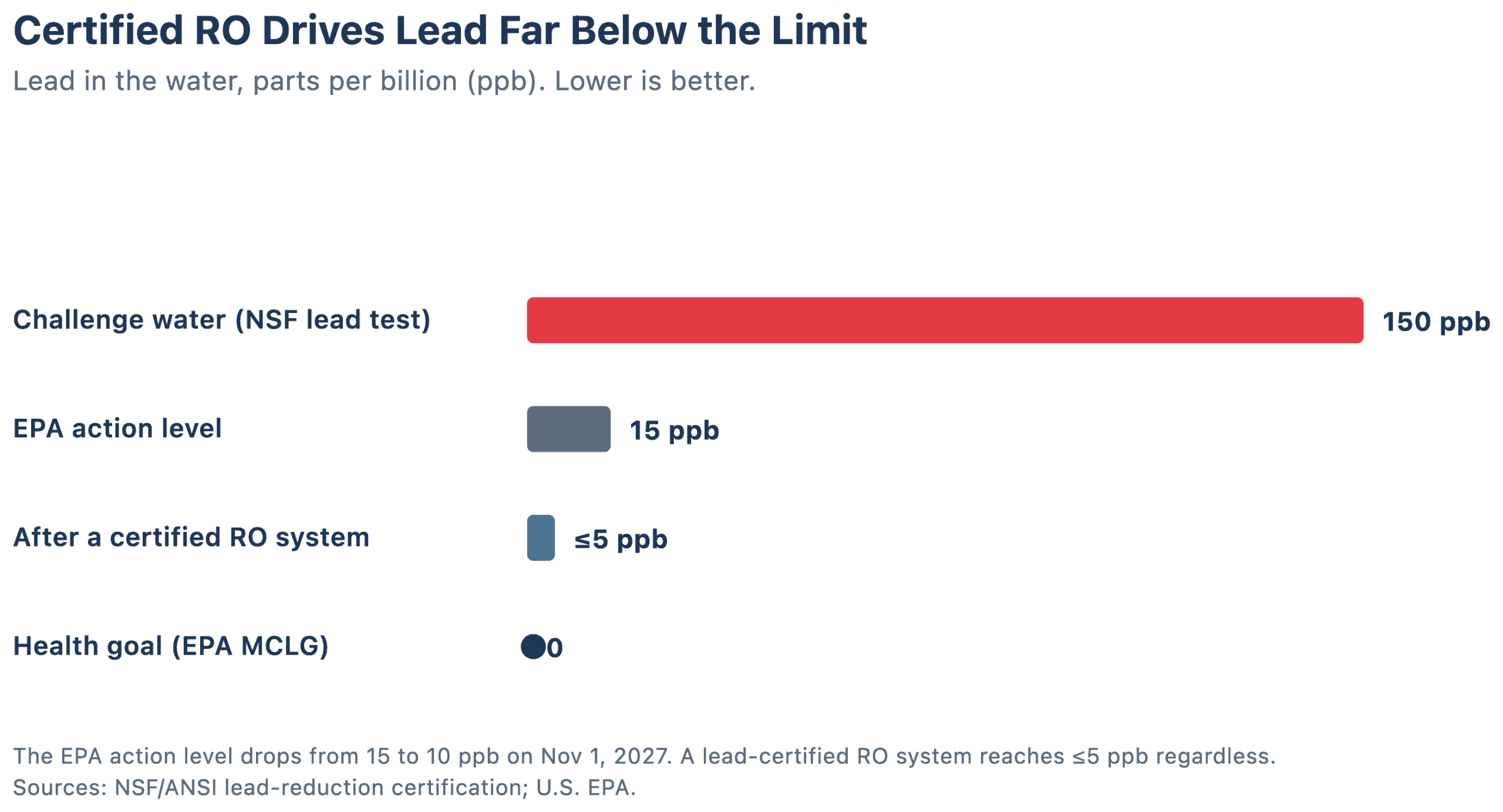
The most trustworthy way to answer "how much" is through certification, not marketing percentages. To be certified for lead reduction under the NSF/ANSI standards, a system is challenged with water containing 150 parts per billion (ppb) of lead and must bring it down to 5 ppb or less (NSF tightened this limit from 10 ppb to 5 ppb). That is a reduction of roughly 97% or more, from a heavily contaminated sample to a level well below where it matters.
For context, the EPA's action level for lead is 15 ppb (dropping to 10 ppb on November 1, 2027, under the updated Lead and Copper Rule). A certified RO system drives lead to 5 ppb or less, comfortably under that line. So rather than trusting a vague "99.9%" claim on a box, look for the certification, which guarantees a tested result.
Why Removing Lead Matters
Lead is not a contaminant to be casual about. The EPA has set the maximum contaminant level goal for lead at zero "because lead is a toxic metal that can be harmful to human health even at low exposure levels." The CDC is equally direct: "No safe blood level has been identified for young children."
The risk is highest for children and during pregnancy. The EPA notes that during pregnancy, lead stored in the mother's bones is released and "can also cross the placental barrier exposing the fetus to lead," with effects that can include reduced fetal growth and premature birth. And the exposure through water is not trivial: the EPA estimates drinking water "can make up 20 percent or more of a person's total exposure to lead," and for "infants who consume mostly mixed formula," water can account for 40 to 60 percent of their lead exposure. That is precisely why treating the water you actually drink and cook with, at the tap, is worthwhile.
Where the Lead Comes From (and Why the Tap Matters)
Lead almost never comes from the original water source. It gets into your water from your home's own plumbing. The EPA identifies "lead pipes, faucets, and fixtures" as the common sources, with "lead service lines... typically the most significant source." The CDC adds that "household plumbing fixtures, welding solder, and pipe fittings made prior to 1986 may also contain lead," and that lead enters the water "when a chemical reaction occurs in plumbing materials that contain lead," especially as water sits.
Because the lead is added on the way to your faucet, a point-of-use filter at that faucet is well placed to catch it before you drink it. (For the scale of the problem, see how New York City alone has an estimated 185 million feet of lead service lines.)
The Honest Caveat: RO Protects the Tap, Not the Source
Here is the point vendors tend to skip. A reverse osmosis system is, in the EPA's words, "connected to a single fixture (e.g., under the kitchen sink)." It treats the water supplied to that one tap. That makes it excellent for your drinking and cooking water, but it does two things it cannot do:
- It does not treat the rest of your house. Other taps, and the water in your bathtub or washing machine, are untreated. For lead, this is usually fine because the concern is ingestion, but it is worth understanding.
- It does not remove the lead source. If a lead service line or old lead plumbing is feeding your home, that pipe is still there. RO is drinking-water protection, not a reason to skip service-line replacement when that option is available.
So the accurate framing is: reverse osmosis reliably gives you low-lead water at the tap it is on. Treat it as a strong, immediate safeguard, and pursue removing lead plumbing as the longer-term fix.
Reverse Osmosis vs a Carbon Filter for Lead
Reverse osmosis is not the only certified way to remove lead. Certain carbon block filters, including some pitcher, faucet-mount, and under-sink units, are also certified for lead reduction, and the CDC specifically points consumers to a filter "certified by an independent testing organization" for "NSF/ANSI standard 53 for lead removal." So a good carbon filter can handle lead too.
Reverse osmosis's advantage is breadth. Alongside lead, the EPA notes RO systems remove "volatile organic compounds (VOCs), PFAS, arsenic, bacteria, and viruses," and RO also handles PFAS and a wide range of dissolved solids at once. If lead is your only concern, a certified carbon filter may be simpler and cheaper; if you want a broad barrier against many contaminants, RO is the stronger choice.
What to Check Before You Buy
For lead specifically, use this checklist:
- Certified for lead. Look for NSF/ANSI 58 (the reverse osmosis standard) or NSF/ANSI 53 (the health-contaminant standard), with a specific lead-reduction claim. Verify the exact model on the certifier's own listing, not the marketing on the box.
- Understand it is point-of-use. It protects the tap it is installed on. Put it where you draw drinking and cooking water.
- It is not a source fix. If you have a lead service line, RO protects your water now; replacing the line is the permanent fix.
If you want help choosing a system, our guide to the best reverse osmosis system for home walks through certified options.
Disclosure: This article is informational and not personalized medical advice. World Water Reserve may earn a commission from qualifying purchases made through links on this page, at no extra cost to you.
Key Takeaways
- Yes, reverse osmosis removes lead very effectively; certified systems reduce it by roughly 97% or more at the certification challenge.
- Certification is the number that matters: a lead-certified system takes 150 ppb down to 5 ppb or less, well under the EPA action level of 15 ppb (10 ppb from November 2027).
- RO removes lead because the membrane rejects the dissolved lead that leaches from pipes and fixtures.
- Lead is toxic with no safe level, especially for children and during pregnancy; water can be 20% or more of total exposure, and up to 40 to 60% for formula-fed infants.
- Lead comes from your home's plumbing, not the source water, which is why point-of-use treatment at the tap works.
- The honest caveat: RO is point-of-use and protects that tap, not the whole house, and it does not replace removing a lead service line.
- Certified carbon filters can also remove lead (NSF/ANSI 53); RO's edge is removing lead plus a broad range of other contaminants.
- Look for NSF/ANSI 58 or 53 certification with a specific lead claim, and verify the model on the certifier's listing.
Share this post!