5 of these 7 fluoride filters are certified for fluoride; 2 rely on maker claims. Compare under-sink, countertop, pitcher and whole-house picks by price.
Our product recommendations are made through independent research based on certifications, specs, and real-world use, and we hands-on test select products (noted on the ones we've tested). Some links are affiliate links; if you buy, we may earn a commission at no cost to you. Read our affiliate disclaimer here.
Our Choice for Best Fluoride Filter
Waterdrop G3P800
- Tankless under-sink RO
- Certified for fluoride (NSF/ANSI 58)
Click for Best Price!

The short answer: To remove fluoride reliably, use reverse osmosis (RO), or a filter whose certification lists fluoride by name. Five of our seven picks hold that certification. The Waterdrop G3P800 (~$999) is our top under-sink pick. The AquaTru Classic (~$475) is our top countertop RO pick. On a tight budget, the RKIN Zero Installation Purifier (~$370 on sale) is the lowest-priced certified RO unit here. Standard carbon pitchers like Brita are not designed to remove fluoride.
Before you buy: Look up your fluoride level first. City water systems must send customers an annual water quality report by July 1, listing the contaminants they detected (EPA). For a private well, a lab test is the only way to know. Your local health department can tell you where to send a sample (CDC).
| Filter | Best for | Fluoride proof | Type | Price | Check price |
|---|---|---|---|---|---|
| Waterdrop G3P800 | Best overall (under-sink) | Certified: NSF/ANSI 58 (IAPMO) | Tankless RO | ~$999 | Waterdrop |
| AquaTru Classic | Best countertop RO | Certified: NSF/ANSI 58 (IAPMO) | Countertop RO | ~$475 | Amazon |
| AquaTru Carafe Alkaline | Best glass carafe | Certified: NSF/ANSI 58 (IAPMO) | Countertop RO | ~$395 | Amazon |
| RKIN Zero Installation Purifier | Best budget RO | Certified: NSF/ANSI 58 (IAPMO) | Countertop RO | ~$370 | RKIN |
| Culligan ZeroWater 40-Cup | Best non-RO option | Certified: NSF/ANSI 53 (IAPMO) | Ion-exchange dispenser | ~$90 | Amazon |
| Clearly Filtered Pitcher | Best long-life pitcher | Maker lab claim only | Pitcher | ~$110 | Clearly Filtered |
| SoftPro Fluoride & Chlorine+ SUPER | Whole house (city water) | Maker claim only | Bone char + carbon tank | ~$1,267 | SoftPro |
Prices were checked on the makers' sites on October 4, 2026, and change often.
How We Chose These Fluoride Filters
This list is research-based. We did not test these units ourselves. Instead, we ranked them by the strongest evidence we could check:
- A certification that names fluoride. We searched the live listings of the three main certifiers: NSF, IAPMO and WQA. A product counts as certified for fluoride only if fluoride appears on its own listing.
- Published test data. Where a filter is not certified for fluoride, we say so and report the maker's own lab claim.
- Running cost and availability. We priced replacement filters on each maker's site and checked that every unit is still sold.
Five picks are certified for fluoride. Two are not: the Clearly Filtered pitcher and the SoftPro whole-house tank. We kept them because they fill gaps our certified picks leave: a pitcher with a 100-gallon filter, and whole-house treatment. We label them clearly.
Certified vs. Lab-Claimed: What a Fluoride Claim Means
NSF/ANSI 58 is the standard for home reverse osmosis systems. It requires every certified system to reduce total dissolved solids (TDS). Fluoride is a separate, optional claim (NSF). So an RO system can carry an NSF/ANSI 58 mark without being certified for fluoride. Check that fluoride is on the listing.
NSF/ANSI 53 is the standard for health-related claims on non-RO filters, such as lead. IAPMO certifies the Culligan ZeroWater filter for fluoride under NSF/ANSI 53 (IAPMO listing). It is the only pitcher-style filter we found with a fluoride certification.
A certified claim is one an independent body tested and still audits. A lab claim is a test the maker paid for or ran and then published. Lab claims can be accurate, but nobody checks them on an ongoing basis.
In the NSF/ANSI 58 fluoride test, a system must cut 8 mg/L test water to 1.5 mg/L or less. That works out to at least an 81% reduction. Our three certified RO picks with published results scored 88% to 96%. The AquaTru Carafe averaged 96.4%, per its performance data sheet.

The 7 Best Fluoride Water Filters
1. Waterdrop G3P800: Best Overall Fluoride Filter (Under-Sink)

The Waterdrop G3P800 is a tankless under-sink RO system with its own faucet. It is certified by IAPMO to NSF/ANSI 58 for fluoride, TDS and five other contaminants (IAPMO listing). In that certification test it cut fluoride by 88.23%, according to Waterdrop's performance data sheet.
It is also certified to NSF/ANSI 42 for chlorine, NSF/ANSI 53 for PFOA and PFOS, and NSF/ANSI 372 for lead-free materials. Waterdrop rates it at 800 gallons per day with a 3:1 pure-to-drain ratio.
- Price: ~$999 list (Waterdrop offered $849 with a promo code in October 2026)
- Filter life: 550 gal (sediment), 1,100 gal (carbon), 2,200 gal (RO membrane)
- Annual filter cost: ~$160 (Waterdrop's own estimate)
- Warranty: 1 year
Pros: certified fluoride reduction at the tap; no bulky storage tank; filtered water on demand; quick-connect fittings that Waterdrop says install in about 30 minutes.
Cons: you need under-sink space and a drain connection; you may need to drill a faucet hole; renters may not be allowed to install it.
Best for: homeowners who want certified fluoride reduction from a dedicated faucet.
2. AquaTru Classic: Best Countertop Fluoride Filter
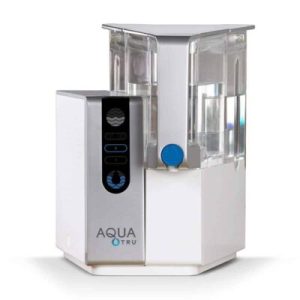
The AquaTru Classic is a four-stage countertop RO system. You fill its tank from the tap and plug it in, with no plumbing. It is certified by IAPMO to NSF/ANSI 58 for fluoride, lead, arsenic, nitrate and more (IAPMO listing). It averaged 93.5% fluoride reduction in testing, per the AquaTru performance data sheet.
It also holds certifications to NSF/ANSI 42 (chlorine), 53 (including PFOA and PFOS), 401 (including microplastics) and 372. AquaTru says it is certified for 84 contaminants in all.
- Price: ~$475 (an optional Mineral Boost filter adds $20)
- Filter life: 600 gal (pre-filter and VOC filter), 1,200 gal (RO)
- Annual filter cost: ~$130
- Speed: about a gallon every 10 to 15 minutes
- Warranty: 1 year
Pros: certified to five NSF/ANSI standards, covering 84 contaminants by AquaTru's count; no installation, so it suits renters; moderate filter cost.
Cons: it sends about 1 gallon to drain for every 3 gallons it purifies (75% efficiency rating); it takes a permanent spot on the counter; you refill it by hand.
Best for: renters and anyone who wants certified fluoride reduction without touching the plumbing.
3. AquaTru Carafe Alkaline: Best Glass-Carafe Fluoride Filter

The AquaTru Carafe is a smaller countertop RO unit that fills a 64-ounce glass carafe. The Carafe models are certified by IAPMO to NSF/ANSI 58 with fluoride on the listing (IAPMO listing). In certification testing it averaged 96.4% fluoride reduction, the highest published result among our RO picks, per AquaTru's data sheet.
The Alkaline version, which our link points to, swaps in a final filter that adds calcium and magnesium back. The standard Carafe costs $20 less.
- Price: ~$395 (Alkaline); ~$375 (standard)
- Filter life: 300 gal (pre-filter and final filter), 600 gal (RO)
- Annual filter cost: ~$215 at 1.5 gallons a day; about $140 at light use
- Output: 35 gallons per day, about half a gallon per batch
- Warranty: 1 year
Pros: the highest published fluoride result among the RO picks; filtered water ends up in glass, not plastic; small footprint.
Cons: lower efficiency (63%) means more water to drain than the Classic; small batches; AquaTru recommends softened water above 10 grains per gallon of hardness.
Best for: one or two people who want certified fluoride reduction served in glass.
4. RKIN Zero Installation Purifier: Best Budget RO Fluoride Filter

The RKIN Zero Installation Purifier is the least expensive RO system on this list that is certified for fluoride. IAPMO certifies it to NSF/ANSI 58 for TDS, fluoride, lead and chromium (IAPMO listing). RKIN does not publish a fluoride reduction percentage, but the listing confirms the certified claim.
You pour a gallon of tap water into the bottom tank and press one button. RKIN says about half a gallon of purified water fills the top tank in about 15 minutes. It comes in two versions: AlcaPure adds minerals back, and OnliPure leaves the water at near-zero TDS.
- Price: ~$370 on sale (list $490)
- Annual filter cost: ~$80 for RKIN's yearly AlcaPure kit, plus a $75 RO membrane every 2 to 4 years
- Efficiency: 1:1 (RKIN rates it at 50% recovery)
- Power: 24 watts
- Warranty: 1 year
Pros: certified fluoride reduction for the lowest price of any RO pick here; no plumbing; low yearly filter cost.
Cons: half the water you pour in goes to waste; small batches; you refill and empty the tanks by hand.
Best for: renters and small households on a budget who still want a certified fluoride claim.
5. Culligan ZeroWater 40-Cup Dispenser: Best Non-RO Fluoride Filter

The Culligan ZeroWater 40-Cup is a glass countertop dispenser with a five-stage ion-exchange filter. Its filter is IAPMO-certified to NSF/ANSI 53 for fluoride, lead, mercury, PFAS and chromium-6 (IAPMO listing). It is the only non-RO filter we found with a fluoride certification. It needs no power and no plumbing.
The catch is filter life. The certification rates each filter at just 20 gallons, so replace it every 20 gallons to stay within the certified fluoride rating. The included TDS meter is a backup check; it measures dissolved solids, not fluoride.
- Price: ~$90 (model ZEROD40)
- Filter life: 20 gallons (certified rating)
- Annual filter cost: ~$125–$170 at half a gallon a day; about double at a gallon a day
- Capacity: 40 cups (2.5 gallons)
Pros: certified fluoride reduction without RO, power or plumbing; glass tank; included TDS meter.
Cons: the shortest filter life here, so costs climb with use; the older "Legacy ZeroWater" ZR-series filters are not certified for fluoride.
Best for: light users who want a certified fluoride option with no installation. Buy the Culligan-branded ZeroWater replacement filters to keep the certified claim.
6. Clearly Filtered Pitcher: Best Long-Life Pitcher (Not Certified for Fluoride)

The Clearly Filtered pitcher uses a three-stage filter that lasts 100 gallons. Clearly Filtered says outside labs it hired measured fluoride reduction above 99.5%. That is a lab claim, not a certification. WQA certifies this pitcher only to NSF/ANSI 42 for chlorine taste and odor, and to 372 for lead-free materials (WQA listing).
- Price: ~$110 (or $99 with a filter subscription)
- Filter life: 100 gallons, about 2 to 3 months
- Annual filter cost: ~$225–$390, at $56–$65 per filter and 4 to 6 filters a year
- Warranty: limited lifetime
Pros: fits most refrigerator doors; no power or installation; filter lasts five times longer than a ZeroWater filter.
Cons: its fluoride claim is not independently certified; high yearly filter cost.
Best for: people who want a fridge-door pitcher and accept a maker's lab claim. If you need a certified claim, choose a Culligan ZeroWater pitcher, which uses the same certified filter as our #5 pick, or an RO system.
7. SoftPro Fluoride & Chlorine+ SUPER: Whole-House Option (Not Certified)

The SoftPro Fluoride & Chlorine+ SUPER is the only whole-house pick here. It treats water where it enters the home, using catalytic carbon plus bone char. SoftPro claims up to 99% fluoride reduction. We found no NSF, IAPMO or WQA listing for any SoftPro product, so that claim is unverified. Bone char does have a long record of removing fluoride (WHO).
- Price: ~$1,267 (list $1,926.50)
- Media life: 600,000 to 1,000,000 gallons, or 6 to 10 years, per SoftPro. This is an overall media rating; SoftPro publishes no fluoride-specific capacity.
- Running cost: no cartridges; SoftPro does not publish a media refill price
- Warranty: limited lifetime
Pros: covers every faucet and shower; no cartridges to swap; also targets chlorine and chloramine.
Cons: no independent certification; SoftPro says it is not recommended for private wells; it installs on the main line, so many owners hire a plumber.
Best for: city-water homes that want whole-house treatment. For a certified fluoride claim at the kitchen tap, add or choose one of the RO picks above.
Which Filter Types Remove Fluoride?
Fluoride is a dissolved ion, so ordinary carbon does not catch it well. These methods do:
- Reverse osmosis (RO) pushes water through a membrane with pores of about 0.0001 micron (CDC). NSF's own database lists fluoride claims only for RO systems. Certified units must cut fluoride by at least 81% in the NSF/ANSI 58 test. Our certified picks with published results scored 88% to 96%, per maker data sheets such as Waterdrop's. Check each model's sheet. See our guides to under-sink RO systems and countertop RO systems.
- Activated alumina is a porous form of aluminum oxide that adsorbs fluoride. It works best on slightly acidic water, near pH 5 (WHO). Poorly regenerated media can release aluminum.
- Bone char is charred animal bone, mostly calcium phosphate. It takes up fluoride (WHO), which is why some whole-house systems use it. It is not an option for people who avoid animal products.
- Ion exchange can remove fluoride when the resin is designed for it, as in the ZeroWater filter. These filters run out quickly.
- Distillation boils water and condenses the steam, leaving fluoride and most minerals behind. It does not remove some volatile organic compounds (CDC). See our water distiller guide.
Standard carbon pitchers, fridge filters and faucet filters are not certified for fluoride. For more methods, read how to remove fluoride from water.
Fluoride and Children: What the Research Says
Dental fluorosis. Too much fluoride while teeth form, up to about age 8, can cause white streaks on teeth (CDC). Formula mixed with fluoridated tap water can raise that risk if it is a baby's main food. The CDC suggests using low-fluoride bottled water some of the time. Look for labels such as deionized, purified, demineralized or distilled.
If your water has more than 2 mg/L of fluoride, your utility must warn customers (EPA). EPA's required notice says children 8 and younger should get another water source, or water treated to remove fluoride (40 CFR 141.208).
Neurodevelopment. In 2024, the National Toxicology Program concluded with moderate confidence that fluoride above 1.5 mg/L is associated with lower IQ in children (NTP). That level is about twice the 0.7 mg/L that U.S. guidelines recommend. The studies came mostly from outside the U.S. NTP found too little data to judge the effect of 0.7 mg/L.
Know your number first. If it is above 1.5 to 2 mg/L, a filter certified for fluoride lowers it in the water your household drinks. For infant formula, follow CDC's bottled-water advice above, or ask your pediatrician.
Fluoridation Policy in 2026
Community water fluoridation is the practice of adjusting fluoride in public water to prevent cavities. The U.S. Public Health Service recommends 0.7 mg/L for communities that fluoridate (CDC). Policy is shifting:
- Utah banned fluoridation of public water as of May 7, 2025 (HB 81).
- Florida followed on July 1, 2025 (SB 700).
- EPA began re-reviewing its 4 mg/L fluoride limit in April 2025 and published its assessment protocol in August 2026 (EPA). The limit has not changed.
As of October 2026, CDC still recommends fluoridation where communities choose it (CDC).
Frequently Asked Questions
Does any filter remove fluoride completely?
No home filter guarantees zero fluoride. Certified RO systems remove most of it. Our certified RO picks with published results cut fluoride by 88% to 96% in the NSF/ANSI 58 test, which starts with 8 mg/L water (Waterdrop data sheet). At typical tap levels, very little is left.
Should you filter fluoride out of your water?
It depends on your level and your household. At the 0.7 mg/L that U.S. guidelines recommend, CDC still recommends fluoridation to prevent cavities. Filtering makes more sense if your water is above 1.5 to 2 mg/L (NTP). For infant formula, CDC suggests low-fluoride bottled water some of the time (CDC). If you are unsure, ask your doctor or dentist.
Do Brita filters remove fluoride?
No. Brita says its filters keep fluoride in fluoridated tap water (Brita). Most carbon pitchers work the same way.
Do Berkey filters remove fluoride?
Not on their own. Berkey sells add-on PF-2 filters for fluoride, but they are not certified. Black Berkey elements have had limited availability since EPA stop-sale orders in 2022 and 2023. EPA says their silver makes them unregistered pesticides. In September 2026, a federal appeals court upheld a ruling that refused to block those orders (First Circuit). Read our Big Berkey review for more.
Do gravity filters remove fluoride?
Most are not certified for fluoride. The Culligan ZeroWater dispenser above is gravity-fed and certified, but each filter lasts only 20 gallons. Berkey's PF-2 add-on is not certified. ProOne publishes fluoride data only for its older G2.0 element, not the current one.
How do I know if my water has fluoride?
Check your utility's annual water quality report, also called a Consumer Confidence Report (EPA). For a well, send a sample to a certified lab. See our guide on how to test water quality.
Key Takeaways
- Look for fluoride on the certification listing. NSF/ANSI 58 covers TDS by default; fluoride is an extra claim.
- Best overall: Waterdrop G3P800 (~$999), certified under-sink RO.
- Best countertop: AquaTru Classic (~$475), certified with no plumbing.
- Best glass carafe: AquaTru Carafe Alkaline (~$395), with the highest certified fluoride result among the RO picks.
- Best budget RO: RKIN Zero Installation Purifier (~$370 on sale), the lowest-priced certified RO pick.
- Best without RO: Culligan ZeroWater 40-Cup (~$90), certified but short-lived filters.
- Not certified for fluoride: the Clearly Filtered pitcher and the SoftPro whole-house system. SoftPro is for city water only.
- Test first. Your water report or a lab test tells you whether you need a fluoride filter at all.
Comparing more options? See our guides to the best under-sink water filters, portable water filters and whole-home filtration systems.
Share this post!