
Distilled water is water purified by distillation: boiled into steam, then condensed back to liquid, leaving minerals and contaminants behind. Here’s what’s in it and how it differs from tap and purified water.
Distilled water is water that has been purified by distillation, a process that boils water into steam and then condenses that steam back into liquid in a separate container. Because minerals, salts, and most contaminants have higher boiling points than water, they are left behind, and what condenses is nearly pure H₂O with almost no dissolved solids.
In practical terms, distilled water is about the purest drinking water you can make: no calcium or magnesium, no dissolved metals, and no microbes. That purity is why it tastes flat and why it is prized for uses where minerals cause problems. It is safe to drink, though it is more often used in appliances, medical settings, and labs than poured from the fridge.
How Distilled Water Is Made
The method is simple in principle. Water is heated until it boils and turns to steam. That steam rises away from the contaminants, which stay behind in the boiling chamber, and is then cooled so it condenses back into liquid water in a clean container. The University of Nebraska–Lincoln Extension describes it: "the steam rises and enters a cooling section... the steam cools, condenses back to a liquid, and the water flows into a storage container."
You can do this on a stovetop or with an electric countertop distiller. We cover the step-by-step in how to make distilled water.
What's In Distilled Water (and What Isn't)
The defining trait of distilled water is what is missing. Distillation, per the same extension, "can remove nearly all impurities from water," up to 99.5%, including "sodium, hardness compounds such as calcium and magnesium, other dissolved solids (including iron and manganese), fluoride, and nitrate," and it "effectively inactivates microorganisms such as bacteria, viruses, and protozoan cysts."
That leaves water with a total dissolved solids (TDS) level near zero. Two side effects follow:
- It tastes flat. With no minerals or dissolved gases, there is nothing to give the water flavor. The extension notes distillation "removes some oxygen, along with trace metals," which is why people describe distilled water as "flat" or "bland."
- It is slightly acidic. Distilled water tends to sit around pH 5.8 because it absorbs a little carbon dioxide from the air, forming weak carbonic acid. For perspective, normal rain is near pH 5.6. This is ordinary chemistry, not a safety concern.
One honest caveat: distillation is not perfect on volatile organic compounds (VOCs) like benzene, which can boil off with the steam unless the distiller has a carbon filter. For everything else, it is about as thorough as home purification gets.
How Distilled Water Differs From Other Water
"Distilled" describes a method, and it sits inside a bigger category. Under the FDA's bottled water rules, "purified water" is water produced "by distillation, deionization, reverse osmosis, or other suitable processes." So distilled water is one type of purified water, alongside reverse osmosis water and deionized water. We break that down in distilled water vs purified water and distilled water vs reverse osmosis.
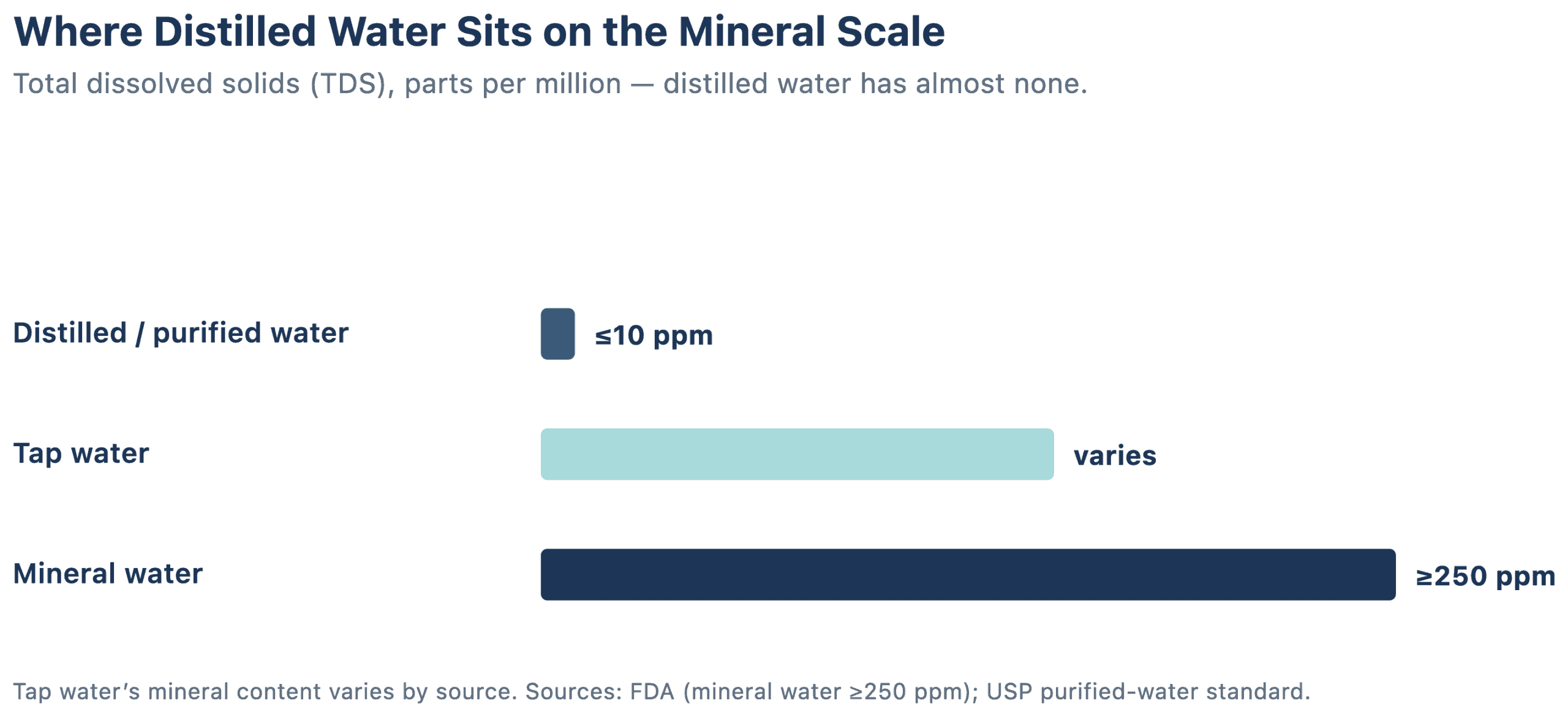
Compared with the water you usually drink, the difference is minerals:
- Tap water contains dissolved minerals and is treated but not demineralized.
- Spring and mineral water are mineral-rich; the FDA defines mineral water as containing "not less than 250 ppm total dissolved solids."
- Distilled (and other purified) water sits at the opposite end, with dissolved solids near zero.
Is Distilled Water Safe to Drink?
Yes. Distilled water is safe to drink; it is simply very pure. The only nuance is nutritional: because it contains no minerals, it contributes no calcium or magnesium, which for most people eating a normal diet is easily covered by food. If distilled water were someone's sole long-term source, the standard advice is to remineralize it. We go deeper in can you drink distilled water.
What Distilled Water Is Used For
Distilled water's lack of minerals makes it the preferred choice wherever mineral scale or residue causes trouble:
- Appliances: CPAP machine humidifiers, steam irons, and household humidifiers, where minerals would leave scale.
- Automotive: topping off lead-acid car batteries.
- Medical and lab: sterilization, medical devices, and laboratory work that require mineral-free water.
- Aquariums and specific recipes: where you want to control mineral content precisely.
(This is standard appliance and equipment guidance; always check your device's manual for its specific recommendation.)
If you want to produce distilled water at home rather than buy it by the gallon, our guide to the best water distillers for home covers the options.
Disclosure: This article is informational and not personalized medical advice. World Water Reserve may earn a commission from qualifying purchases made through links on this page, at no extra cost to you.
Key Takeaways
- Distilled water is water purified by distillation: boiled into steam, then condensed back to liquid, leaving minerals and contaminants behind.
- It is nearly pure H₂O with a total dissolved solids level near zero and no calcium, magnesium, or microbes.
- Distillation removes up to 99.5% of impurities and inactivates bacteria, viruses, and cysts, though VOCs can carry over without a carbon filter.
- It tastes flat because the minerals and dissolved gases are gone, and it is slightly acidic (around pH 5.8), which is normal.
- Distilled water is one type of "purified" water, alongside reverse osmosis and deionized water; mineral water, by contrast, has at least 250 ppm dissolved solids.
- It is safe to drink; if it were your only source, remineralizing is the standard advice.
- It is most commonly used in appliances, car batteries, and medical or lab settings where mineral-free water matters.
Share this post!