
Seven activated carbon water filters, from a $22 pitcher to whole-house systems, compared by what each is certified to reduce, filter cost per year and install type. Prices checked October 2026.
Our product recommendations come from independent research based on certifications, maker specs and published test data. If we’ve tested a product hands-on, the review says so. Some links are affiliate links; if you buy, we may earn a commission at no cost to you. Read our affiliate disclaimer here.
Our Choice for Best Activated Carbon Filter
Aquasana Claryum 3-Stage
- Certified for chloramine, lead and PFOA/PFOS
- About $168 a year in filters

The short answer: For most homes, the best activated carbon water filter is the Aquasana Claryum 3-Stage (~$165) under the sink. It is certified to reduce chlorine, chloramine, lead, cysts and PFOA/PFOS, two common PFAS ("forever chemicals"). On a tight budget, a Brita pitcher with the Elite filter (~$22) is certified for lead, and its filters cost about $33 a year. The PUR PLUS (~$33) is our faucet pick. If you can't drill a faucet hole, choose the Aquasana Claryum Direct Connect (~$125). For whole-house chlorine and chloramine on city water, the SpringWell CF1 (~$1,160) costs less than the Aquasana HealthShield (~$2,099), but the SpringWell holds no certification. The HealthShield is certified for PFAS, not for chlorine or chloramine.
Before you buy: Find out what is in your water. City water systems publish an annual water quality report (EPA). A private well needs a lab test (CDC). Then choose a filter whose certification lists those contaminants by name.
| Filter | Best for | Type | Price | Yearly filter cost | Check price |
|---|---|---|---|---|---|
| Aquasana Claryum 3-Stage | Best overall | Under-sink, own faucet | ~$165 | ~$168 | Aquasana |
| Brita Elite pitcher | Best pitcher | Pitcher | ~$22 | ~$33 | Amazon |
| PUR PLUS | Best faucet filter | Faucet mount | ~$33 | Not published (4 or more filters) | Amazon |
| Aquasana Claryum Direct Connect | Best no-drill under-sink | Under-sink, uses your faucet | ~$125 | ~$184 | Aquasana |
| ProOne Big+ | Best countertop gravity filter | Countertop gravity | ~$184 | ~$126 or more (one filter) | Amazon |
| SpringWell CF1 | Whole house, city water (not certified) | Whole-house tank | ~$1,160 | ~$28 to $42 + media at 10 years | SpringWell |
| Clearly Filtered pitcher | Lab-tested alternative | Pitcher | ~$110 | ~$223 to $260 (more for 3+ people) | Clearly Filtered |
Prices were checked on each seller's site on October 4, 2026, and change often. Amazon prices move daily.
What Each Filter Is Certified to Reduce
A ✓ means the contaminant appears on the product's certification listing. "Lab" means the maker reports a lab test, but no certifier lists the claim. "Claim" means the maker says so but publishes no test. "No" means no certifier lists it. See Certified vs. Lab-Tested Claims.
| Filter | Chlorine | Chloramine | Lead | PFAS | Cysts | Certifier |
|---|---|---|---|---|---|---|
| Aquasana Claryum 3-Stage | ✓ | ✓ | ✓ | ✓ PFOA/PFOS | ✓ | WQA |
| Brita Elite pitcher | ✓ | No | ✓ | No | No | WQA, IAPMO |
| PUR PLUS | ✓ | No | ✓ | ✓ Total PFAS | No | NSF, WQA, IAPMO |
| Aquasana Claryum Direct Connect | ✓ | ✓ | ✓ | ✓ PFOA/PFOS | ✓ | IAPMO |
| ProOne Big+ | ✓ | ✓ | ✓ | ✓ Total PFAS | No | IAPMO |
| SpringWell CF1 | Claim | Claim | No | Claim | No | None |
| Clearly Filtered pitcher | ✓ | Lab | Lab | Lab | No | NSF, WQA (chlorine taste and odor) |
| Aquasana HealthShield (whole house) | Lab | Lab | No | ✓ 5 PFAS | No | WQA |
Sources, checked October 4, 2026. Aquasana: WQA 42, WQA 53. Brita: WQA 42, WQA 53, IAPMO. PUR: NSF, WQA 42, WQA 53. Direct Connect: IAPMO 42, IAPMO 53. ProOne: IAPMO 42, IAPMO 53. Clearly Filtered: WQA. SpringWell holds no NSF, IAPMO or WQA listing.
How We Chose These Carbon Filters
Most of our picks are sold as carbon-based filters, alone or with other media. PUR does not publish the media in its faucet filter; we include the PUR PLUS as our certified faucet option. Our methodology weighs evidence we could check ourselves:
- Certified claims. We searched the live listings of the three main certifiers: NSF, IAPMO and WQA. A claim counts only if it appears on the product's own listing.
- Running cost. We priced replacement filters on each maker's site and used the maker's own replacement schedule.
- Fit. We covered each common format: pitcher, faucet, under-sink, countertop and whole house.
Two picks don't meet the certification bar, and we label them. The SpringWell CF1 holds no certification; it is here because few whole-house carbon systems do. The Clearly Filtered pitcher is certified only for chlorine taste and odor; its other figures are lab tests. These are research-based picks. We did not test them ourselves. We fact-checked every certification, price and link on this page on October 4, 2026. If you spot an error, please contact us. To learn who we are, read more about us.

Yearly filter cost at each maker's price and replacement schedule, October 4, 2026. PUR publishes no filter price, so it is not shown. Clearly Filtered is shown at its lowest yearly cost and SpringWell at its highest (sediment filters only, $28 to $42); the ProOne is shown at one element every 6 months, and most households pay more.
Filter prices and replacement schedules vary widely. The Brita Elite filter lasts 120 gallons, or about 6 months, and a 2-pack costs $32.99 (Brita). The Clearly Filtered pitcher filter lasts 100 gallons, about 3 months, and costs $55.83 to $65 each (Clearly Filtered).
The 7 Best Activated Carbon Water Filters
1. Aquasana Claryum 3-Stage: Best Overall
The Aquasana Claryum 3-Stage is an under-sink filter that uses activated and catalytic carbon with ion exchange. WQA certifies it to NSF/ANSI 42 for chlorine and chloramine. Its NSF/ANSI 53 listing covers lead, mercury, cysts, VOCs, PFOA and PFOS (WQA listing). Of our seven picks, only the Direct Connect, its no-drill sibling, matches that list.
- Price: ~$165 (model AQ-6300)
- Filters: one set every 6 months or 600 gallons, $83.99, so about $168 a year
- Flow: 0.5 gallons per minute (gpm)
- Install: dedicated faucet through a 1/2-inch hole
Pros: certified for chloramine, lead, cysts and PFOA/PFOS; Aquasana says it keeps minerals; twist-off filters.
Cons: you may need to drill a faucet hole; 0.5 gpm is slow for large pots.
Is it for you? Choose it for city water when you want certified claims as broad as any pick here. See our best under-sink water filters for more options.
2. Brita Elite Pitcher: Best Pitcher

Brita Tahoe pitcher shown. The Elite filter also fits the Metro, Everyday and other Brita pitchers.
The Brita Elite is a long-life Brita pitcher filter, rated for 120 gallons or about 6 months. WQA certifies it to NSF/ANSI 53 for lead, mercury, cadmium, asbestos and benzene (WQA listing). IAPMO also certifies it for lead, and Brita makes no PFAS claim for the Elite (Brita data sheet). Our link is for the 6-cup Metro pitcher with one Elite filter.
- Price: ~$22 on Amazon
- Filters: one every 120 gallons or about 6 months; a 2-pack is $32.99
- Install: none
Pros: the lowest upfront price and the lowest yearly filter cost we could verify among our certified picks; certified for lead; no plumbing.
Cons: not certified for chloramine or cysts; a 6-cup pitcher needs frequent refills; Brita says hard water can shorten filter life.
Is it for you? Choose it if you rent, live alone or want certified lead reduction for very little money.
3. PUR PLUS: Best Faucet Filter
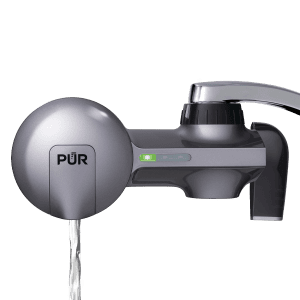
The PUR PLUS (model PFM350V) clips onto your kitchen faucet. A lever switches between filtered and unfiltered water. NSF and WQA both certify it to NSF/ANSI 42, 53 and 401, including lead, mercury and VOCs (NSF listing). NSF's listing also includes microplastics. IAPMO certifies it to NSF/ANSI 53 for Total PFAS as well (IAPMO listing). PUR describes it only as a "3-in-1" Mineral Core filter and does not publish its media.
- Price: ~$33 on Amazon
- Filters: one every 100 gallons or 3 months; a 2-pack costs $27.85 on Amazon
- Install: attaches with no tools
Pros: low upfront cost; certified for lead and Total PFAS; a lever lets you skip the filter for dishwater.
Cons: not certified for chloramine; adds bulk to the faucet; at least four filter changes a year.
Is it for you? Choose it if you want filtered tap water in minutes with no plumbing.
4. Aquasana Claryum Direct Connect: Best No-Drill Under-Sink

A direct-connect filter is one that fits between your cold-water valve and your existing faucet, so there is no hole to drill. The Aquasana Claryum Direct Connect is a single carbon cartridge. IAPMO certifies it to NSF/ANSI 42 for chlorine and chloramine, and to NSF/ANSI 53 for lead, cysts, VOCs, PFOA and PFOS (IAPMO listing).
- Price: ~$125
- Filters: one cartridge every 6 months or 784 gallons, $91.99, so about $184 a year
- Flow: 1.5 gpm
Pros: no drilling; nearly the same certified claims as the 3-Stage; three times its flow rate.
Cons: all cold water from the faucet runs through it, so filters can wear out sooner; higher yearly filter cost than the 3-Stage.
Is it for you? Choose it if you rent or can't drill your countertop.
5. ProOne Big+: Best Countertop Gravity Filter

The ProOne Big+ is a stainless steel gravity filter. You pour water into the top chamber, and it drips through the filter elements. Each G3.0 element combines a ceramic shell with carbon-based media. IAPMO certifies it to NSF/ANSI 42 for chlorine and chloramine, NSF/ANSI 53 for lead and Total PFAS, and NSF/ANSI 401 for microplastics (IAPMO listing).
- Price: ~$184 with one 7-inch element (more with two or three)
- Filters: ProOne says up to 6 months; one element is $63.16
- Certified capacity: 50 gallons per element for lead and PFAS. That is about 2 gallons a week over 6 months, so most households will replace sooner and pay more than ~$126 a year
Pros: no electricity or plumbing; certified for lead and Total PFAS; durable stainless steel.
Cons: slow, as with any gravity filter; a small certified capacity per element; not certified for fluoride or germs.
Safety note: it is not certified to make untreated water safe. If you fill it from a stream, rain barrel or unsafe well, boil or disinfect the water first.
Is it for you? Choose it for an RV, cabin or power-outage backup with treated water.
6. SpringWell CF1: Whole House, City Water (Not Certified)

Catalytic carbon is activated carbon with an oxidizing capability, which makes it more effective than standard carbon at reducing chloramine (WQA). The SpringWell CF1 is a whole-house tank that pairs catalytic carbon with KDF media. SpringWell says it removes chlorine, chloramine, PFOA and PFOS from city water. It publishes no test report, and NSF, IAPMO and WQA list no SpringWell product.
- Price: ~$1,160 (CF1, for 1 to 3 bathrooms, 9 gpm)
- Upkeep: SpringWell rates the carbon media for 1 million gallons or 10 years; the sediment filter is replaced every 6 to 9 months
- Warranty: lifetime on the tank, valve and fittings
Pros: treats every tap and shower; very low yearly upkeep; long media life.
Cons: no certification or published test data; needs plumbing work; built for city water only. SpringWell says not to use it on microbiologically unsafe water.
Is it for you? Choose it if your city uses chloramine and you want filtered water at every tap, and you accept maker claims.
PFAS-Certified Alternative: Aquasana HealthShield

Want certified whole-house PFAS reduction? The Aquasana HealthShield (~$2,099) is the only whole-house carbon system on sale with a reduction certification among the brands we searched: Aquasana, SpringWell, Kind, Express Water and US Water. WQA lists it under NSF/ANSI 53 for PFOA, PFOS, PFHxS, PFNA, PFHpA and VOCs (WQA listing). Its media lasts 165,000 gallons or 2 years, and a replacement tank costs $1,749, so plan on about $1,000 a year. Aquasana says not to use it with microbiologically unsafe water. See the HealthShield.
7. Clearly Filtered Pitcher: Lab-Tested Alternative

The Clearly Filtered pitcher has the longest list of lab results among our pitchers. The maker says it was lab-tested against 365+ contaminants, with published results for fluoride, lead and PFOA. Those are results from labs the maker chose. NSF and WQA certify it only for chlorine taste and odor, plus lead-free materials (WQA listing).
- Price: ~$110 ($99 with a filter subscription)
- Filters: 100 gallons, about 3 months; $55.83 to $65 each, so about $223 to $260 a year, or up to $390 for 3+ people on the 2-month plan
- Warranty: limited lifetime
Pros: published lab data for fluoride; BPA-free; 10-cup size.
Cons: no health-effects certification; filters cost about $223 to $260 a year, more for 3+ people.
Is it for you? Consider it if you want a pitcher with fluoride lab data and accept that no certifier has verified it.
➔ Check price at Clearly Filtered
How Activated Carbon Works
Activated carbon is carbon that has been heated to create millions of tiny pores. Activated charcoal is another name for the same material. Chemicals in the water stick to the walls of those pores, a process called adsorption. One pound has more than 35 acres of surface, almost 100 football fields (WQA). Carbon also reacts with chlorine and turns it into harmless chloride.
Granular activated carbon (GAC) is loose carbon granules. It allows high flow, which suits whole-house tanks. A carbon block is carbon pressed into a solid filter. Water spends more time in contact with it, and many certified blocks reduce lead and cysts, such as the two Aquasana Claryum filters above.
Chloramine is harder to remove than chlorine. Standard carbon needs about four times the contact time, while catalytic carbon is more effective for chloramine (WQA). Some under-sink carbon blocks are also certified for chloramine.
Carbon can reduce PFAS. PFOS and PFOA "can be effectively removed," but shorter-chain PFAS break through sooner (ITRC). That is why the certification matters. PFAS claims are now certified under NSF/ANSI 53, or NSF/ANSI 58 for reverse osmosis (NSF).
What Carbon Filters Don't Remove
- Bacteria and viruses. Carbon is not disinfection, though some carbon blocks are certified to NSF/ANSI 53 to reduce cysts. To remove bacteria and viruses, CDC lists reverse osmosis, distillation, nanofiltration and UV with pre-filtration (CDC). See our UV water purifier guide.
- Fluoride. No certifier lists fluoride for a carbon-only filter. Certified fluoride reduction is almost always a reverse osmosis claim. See our best fluoride water filters.
- Dissolved minerals and salts. Carbon does not soften water or lower total dissolved solids (TDS). For TDS, see our best reverse osmosis systems.
Certified vs. Lab-Tested Claims
NSF/ANSI 42 is the standard for taste and odor claims, such as chlorine. NSF/ANSI 53 is the standard for health claims, such as lead, cysts and PFAS (NSF). A filter certified only to NSF/ANSI 42 improves taste but is not certified to reduce health contaminants.
A certified claim is one an independent body tested and still audits. A lab claim is a test result the maker reports from a lab it chose. For example, Clearly Filtered's fluoride figure is a lab claim, while the Brita Elite's lead reduction is certified.
Activated Carbon Filters and Well Water
Test a private well at least once a year for bacteria, nitrate and other local concerns (CDC). If a test finds germs or harmful chemicals, use bottled water or another safe source and call your health department before you rely on any filter.
None of our picks is certified to make microbiologically unsafe water safe. For bacteria and viruses, add a UV unit with pre-filtration, certified to NSF/ANSI 55 Class A. Carbon is a good final stage for taste, odor and some chemicals once the water is safe. Iron, manganese and sediment can clog carbon quickly, so well systems often treat those first. See our best whole-house filters for well water.
Also Considered
- Aquasana Clean Water Machine (~$185): a powered countertop unit that WQA certifies for lead, PFOA/PFOS and chloramine. It needs an outlet.
- Epic Smart Shield (~$129): IAPMO-certified for lead and VOCs, but not PFAS. Its replacement cartridge was out of stock at Epic on October 4, 2026.
- Epic Pure pitcher (~$84): the best overall pick in EWG's 2024 countertop filter guide. But NSF lists Epic's Pure XP filter only for material safety, and its reduction figures are lab tests the maker reports.
- Kind E-1000 (~$976): a whole-house carbon filter for city water. NSF, IAPMO and WQA list no certification for it.
- Clearly Filtered 3-Stage: certified only for chlorine taste and odor. See our under-sink guide.
- Waterdrop FC-06 faucet filter: no certifier listing, and out of stock at Waterdrop on October 4, 2026.
Frequently Asked Questions
Is activated carbon a good water filter?
Yes, for chemicals that affect taste, odor and health. Certified carbon filters reduce chlorine, and many also reduce lead, VOCs and PFOA/PFOS. Carbon does not disinfect: it is not certified to remove bacteria or viruses. No certifier lists fluoride for a carbon-only filter, and carbon does not soften water or lower total dissolved solids. Some carbon blocks are certified to reduce cysts, such as the two Aquasana Claryum filters.
What is the best activated carbon filter for home use?
For most homes, the Aquasana Claryum 3-Stage under the sink. It is certified for chlorine, chloramine, lead, cysts and PFOA/PFOS. For the lowest price, a Brita pitcher with the Elite filter is certified for lead.
Do activated carbon filters remove PFAS?
Some do: look for PFOA/PFOS or Total PFAS on an NSF/ANSI 53 listing. On this page, the two Aquasana Claryum filters, the PUR PLUS, the ProOne Big+, the Aquasana HealthShield and the Aquasana Clean Water Machine (under Also Considered) hold PFAS certifications. Check the listing, because short-chain PFAS are harder for carbon to hold.
Do activated carbon filters remove lead?
Some do (see do carbon filters remove lead?). Look for lead on an NSF/ANSI 53 listing. The Aquasana Claryum 3-Stage and Direct Connect, the Brita Elite, the PUR PLUS and the ProOne Big+ are all certified for lead. The Aquasana Clean Water Machine and Epic Smart Shield (under Also Considered) are also certified for lead. The HealthShield is not.
Is activated charcoal the same as activated carbon?
Yes. The two names describe the same porous carbon. What matters for a water filter is the form, granular or block, and the certification.
How often should I replace an activated carbon filter?
At the maker's rated gallons or months, whichever comes first. Once carbon reaches its capacity, contaminants can break through into the filtered water, so replace by the maker's gallon rating (University of Nebraska). On this page, the shortest rating is the ProOne's 50-gallon certified capacity per element, which a household drinking a gallon a day uses up in about 7 weeks. The Clearly Filtered pitcher and PUR last about 3 months, and SpringWell's whole-house media is rated for 10 years.
Can I use an activated carbon filter on well water?
Yes, as a final stage once the water is safe. Test the well first. If the test finds germs, use bottled water or another safe source and contact your health department (CDC). Then add disinfection, such as UV with pre-filtration certified to NSF/ANSI 55 Class A (NSF).
Key Takeaways
- Check the listing, not the box: NSF/ANSI 42 covers taste; NSF/ANSI 53 covers health claims such as lead and PFAS.
- Best overall: Aquasana Claryum 3-Stage (~$165), certified for chloramine, lead, cysts and PFOA/PFOS.
- Best pitcher: Brita Elite (~$22), certified for lead, about $33 a year in filters.
- Best faucet: PUR PLUS (~$33). Best no-drill under-sink: Aquasana Claryum Direct Connect (~$125).
- Whole house: SpringWell CF1 costs less but is uncertified; the Aquasana HealthShield is certified for PFAS but costs about $1,000 a year to run.
- Carbon doesn't disinfect. Treat germs separately, especially on a well.
Comparing other filter types? See our guides to the best under-sink water filters, whole-home filtration systems and how to test your water.
Share this post!