Eight home water filtration systems, one per need: whole house, under-sink, RO, countertop, well iron, UV, softener and budget. Certifications checked October 2026.
The short answer: The best water filtration system for your home depends on your water source and what is in it, so test first. On city water, a whole-house carbon filter such as the SpringWell CF1 (~$1,160) treats every tap, though no certifier lists it. For certified lead and PFOA/PFOS reduction at the kitchen sink, choose the Aquasana Claryum 3-Stage (~$165). On a private well, match the system to your test: an iron filter for iron and sulfur, a softener for hard water, and disinfection if bacteria turn up.
Before you buy: A point-of-entry (whole-house) system treats water where it enters your home. A point-of-use system, such as an under-sink or countertop filter, treats one tap. Check what is in your water first. City utilities publish an annual water quality report (EPA), and a private well needs its own water test.
Some links on this page are affiliate links. If you buy through them, World Water Reserve may earn a commission at no extra cost to you. As an Amazon Associate, we earn from qualifying purchases. This guide is informational and not medical advice.
| Your need | Our pick | Certified to reduce | Price | Check price |
|---|---|---|---|---|
| Whole house, city water | SpringWell CF1 | Not certified (maker claims) | ~$1,160 | SpringWell |
| Drinking water, under the sink | Aquasana Claryum 3-Stage | Lead, PFOA/PFOS, mercury, cysts (WQA) | ~$165 | Aquasana |
| Reverse osmosis, tankless | Waterdrop G3P600 | Lead, fluoride, TDS, PFOA/PFOS (IAPMO) | ~$539 | Waterdrop |
| Countertop, no install; PFAS | AquaTru Classic | Lead, fluoride, nitrate, PFOA/PFOS (IAPMO) | ~$475 | Amazon |
| Well water: iron, manganese, sulfur | SpringWell WS1 | Not certified (maker ratings) | ~$2,231 + test | SpringWell |
| UV for a well that tests safe | Aquasana Rhino Well + UV | UV: NSF/ANSI 55 Class B | ~$1,749 | Aquasana |
| Hard water | Aquasana SimplySoft 40K | Hardness, NSF/ANSI 44 (IAPMO) | ~$849 | Aquasana |
| Budget | PUR PLUS faucet filter | Lead, mercury, Total PFAS (IAPMO) | ~$33 | Amazon |
Prices were checked on the maker's site or the linked seller on October 5, 2026, and change often. "Not certified" means no listing at NSF, IAPMO or WQA, so the claims are the maker's own.
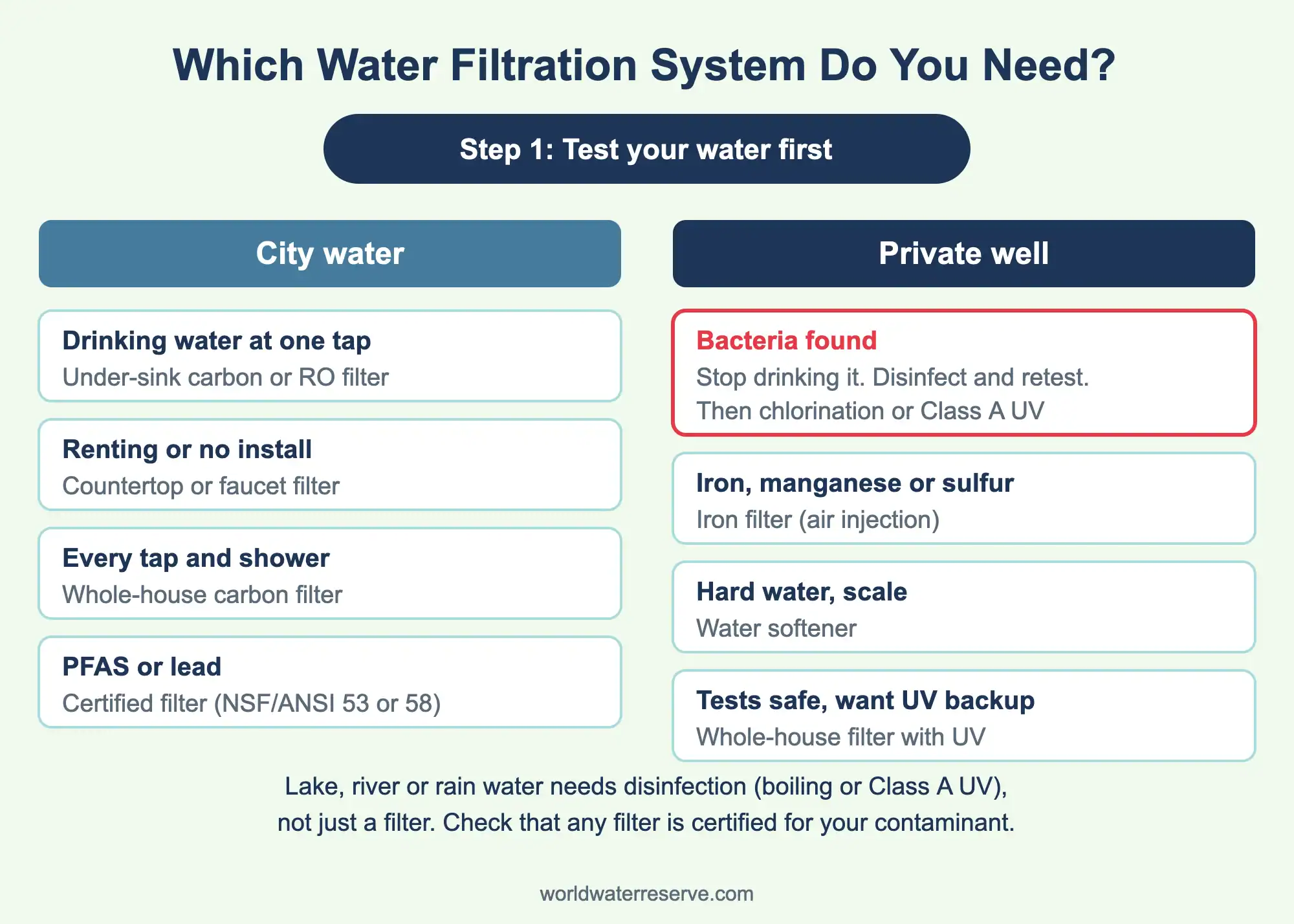
Match your water source and test results to the right system type.
How We Chose These Systems
Our methodology rests on evidence anyone can check:
- Match the expert guide. Each pick comes from one of our type-specific guides, which we fact-checked between October 3 and 5, 2026. Where a guide has a certified pick, the hub shows it.
- Certification. We searched NSF, IAPMO and WQA for every pick and say plainly which claims are certified and which are the maker's own.
- Price and running cost. We list each price as checked on October 5, 2026, and the filter cost for each drinking-water pick.
These are research-based picks. We did not test these eight ourselves. If you spot an error, please contact us. To learn who we are, read more about us.
The 8 Best Water Filtration Systems by Need
1. SpringWell CF1: Best Whole-House Filter for City Water
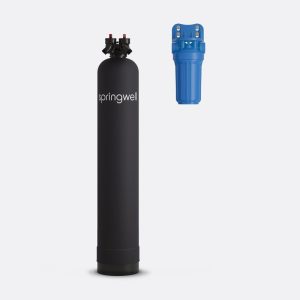
The SpringWell CF1 is a carbon tank that treats every tap in a city-water home. SpringWell says it reduces chlorine, chloramine and PFAS. No certifier lists it, so treat those as maker claims.
- Price: ~$1,160, for 1 to 3 bathrooms
- Media: rated for 1 million gallons; SpringWell's page says 10 years, its manual says 6
- Upkeep: a sediment filter every 6 to 9 months; no electricity
- Warranty: lifetime on covered parts
Want it certified? The Aquasana HealthShield (~$2,099) is WQA-certified to NSF/ANSI 53 for five PFAS and VOCs. It needs a new tank about every two years, so it costs about $1,000 a year to run (Aquasana HealthShield). Aquasana's Rhino (~$999) is a different case. Aquasana says it removes up to 97% of chlorine in independent tests, but WQA's listing for its tank carries no contaminant reduction claims (Aquasana Rhino).
Is it for you? Choose the CF1 for long media life and low upkeep on city water. See our best whole house water filters guide.
2. Aquasana Claryum 3-Stage: Best Under-Sink Filter

The Aquasana Claryum 3-Stage is a carbon filter that sits under the sink with its own faucet. WQA certifies it to NSF/ANSI 53 for lead, mercury, cysts, asbestos, VOCs, PFOA and PFOS (WQA listing). It sends no water to waste, and Aquasana says it keeps minerals.
- Price: ~$165
- Filters: a set every 6 months or 600 gallons, $83.99, so about $168 a year
- Flow: 0.5 gallons per minute
- Install: a dedicated faucet through a 1/2-inch hole
Is it for you? Choose it for city water when lead or PFOA/PFOS is your concern. See our best under-sink water filters guide.
3. Waterdrop G3P600: Best Tankless Reverse Osmosis System

The Waterdrop G3P600 is a tankless reverse osmosis (RO) system. Reverse osmosis is a process that pushes water through a membrane that holds back most dissolved salts and metals. IAPMO certifies the G3P600 to NSF/ANSI 58 for TDS, fluoride, lead, cadmium, barium and radium (IAPMO 58 listing). It is also certified to NSF/ANSI 53 for PFOA/PFOS (IAPMO 53 listing).
- Price: ~$539
- Output: 600 gallons per day, with a 2:1 pure-to-drain ratio, per Waterdrop
- Filters: carbon every 6 to 12 months; membrane every 2 years; about $145 a year, per Waterdrop
- Power: needs an outlet under the sink
Other RO choices: the Waterdrop G3P800 (~$999) holds the same NSF/ANSI 58 claims and is rated for 800 gallons per day, per Waterdrop (Waterdrop G3P800). For nitrate or arsenic (V), the Aquasana SmartFlow (~$240) is certified for both (Aquasana SmartFlow).
Is it for you? Choose the G3P600 for fast tankless water and certified lead, fluoride and PFOA/PFOS reduction. It is not certified for arsenic or nitrate, and RO is not a disinfection method. See our best reverse osmosis systems guide.
4. AquaTru Classic: Best Countertop and PFAS Pick

The AquaTru Classic is a plug-in countertop RO unit that needs no plumbing. IAPMO certifies it to NSF/ANSI 58 for lead, fluoride, arsenic (V), nitrate and TDS (IAPMO listing), and to NSF/ANSI 53 for PFOA and PFOS. On its data sheet, combined PFOA and PFOS fell 97.5%. About 75% of the tap water you add becomes purified water (AquaTru data sheet).
- Price: ~$475 at AquaTru (~$428 on Amazon)
- Filters: about $17 per 100 gallons
- Power: plugs into an outlet
Is it for you? Choose it if you rent or want certified PFAS, fluoride and nitrate reduction with no install. See our best countertop water filters guide.
5. SpringWell WS1: Best for Well Water Iron and Sulfur
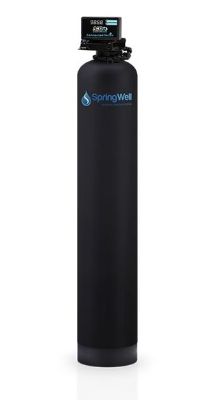
The SpringWell WS1 is an air injection iron filter. Air injection is a process that adds air to the water so dissolved iron, manganese and hydrogen sulfide turn into particles that a media bed traps. SpringWell rates it for up to 7 ppm iron, 8 ppm hydrogen sulfide and 1 ppm manganese. No certifier lists any iron filter we checked, including this one.
- Price: ~$2,231, plus a required water test (~$134)
- Flow: 12 gallons per minute, for 1 to 4 bathrooms
- Limits: water with a pH of 6.5 to 10; not for water that is microbiologically unsafe
- Needs: a drain line and a power outlet
On a budget? The Home Master 3-stage filter (~$504) handles light iron: under 3 ppm iron and 1 ppm manganese, at a pH above 7, per Home Master. It is not for hydrogen sulfide or iron bacteria, and it is not certified (Home Master).
Is it for you? Choose the WS1 for a well with stains, a metallic taste or a rotten-egg smell. See our best whole house water filters for well water guide.
6. Aquasana Rhino Well + UV: Best UV System for a Safe Well
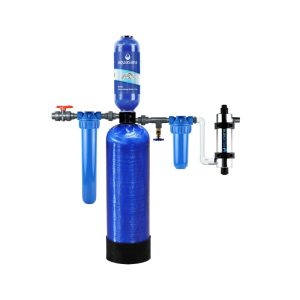
The Aquasana Rhino Well + UV combines a sediment pre-filter, a carbon tank and a UV unit. Its UV unit is certified to NSF/ANSI 55 Class B, the class for water that already tests safe (NSF listing). It is not meant for water with known bacteria.
- Price: ~$1,749
- Capacity: 500,000 gallons or about 5 years; up to 2.5 bathrooms
- Limits: iron under 0.3 ppm, manganese under 0.05 ppm and hardness under 7 grains per gallon, per Aquasana
- Upkeep: a sediment pre-filter about every 2 months and a new UV lamp every year
If your test finds bacteria: stop drinking the water, use a safe source and call your local health department. Disinfect the well and retest. For ongoing protection, use continuous chlorination or a UV system certified to NSF/ANSI 55 Class A, the class for treating contaminated water.
Is it for you? Choose it for a clear, low-iron well that tests safe and is under 7 grains per gallon of hardness, or already softened. See our best UV water purifiers guide, which lists Class A options.
7. Aquasana SimplySoft 40K: Best Certified Water Softener

The Aquasana SimplySoft is a salt-based softener. Ion exchange is the process it uses: a resin trades calcium and magnesium for sodium. IAPMO certifies it to NSF/ANSI 44 for hardness reduction (IAPMO listing).
- Price: ~$849 for 40,000 grains
- Flow: about 11 gallons per minute
- Upkeep: salt, plus a sediment pre-filter every 2 months
Is it for you? Choose it for city water if you want a softener whose capacity a certifier has tested. On a well, test for iron first, since oxidized iron can clog a softener's resin. A softener does not remove chlorine or PFAS, so pair it with a filter if you need one. See our best water softeners guide.
8. PUR PLUS Faucet Filter: Best Budget Pick
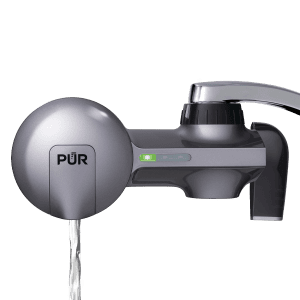
The PUR PLUS is a filter that mounts on your kitchen faucet. IAPMO certifies it to NSF/ANSI 53 for lead, mercury, Total PFAS and VOCs (IAPMO listing).
- Price: ~$33 on Amazon
- Filters: 100 gallons each; a 2-pack costs $27.85 on Amazon, about $14 per 100 gallons
Prefer a dispenser? The Culligan ZeroWater 40-cup dispenser (~$72) adds certified fluoride and nitrate reduction, but its filters last only 20 gallons (ZeroWater).
Is it for you? Choose it if you rent or want certified lead and PFAS reduction for the lowest upfront price.
Also Considered
SpringWell UV (~$1,101): a whole-house UV system rated for up to 15 gallons per minute. It is not certified to NSF/ANSI 55, so use it only on water that tests safe (SpringWell UV).
What the Certifications Mean
NSF, IAPMO and WQA all certify filters to the same NSF/ANSI standards. A certification covers only the claims on the listing:
- NSF/ANSI 42: taste and odor, such as chlorine.
- NSF/ANSI 53: health claims, such as lead, PFAS and cysts.
- NSF/ANSI 58: reverse osmosis, including TDS, fluoride and arsenic.
- NSF/ANSI 55: UV systems. Class A treats contaminated water; Class B is for water that already tests safe.
- NSF/ANSI 401: emerging contaminants, such as microplastics and some medicines.
- NSF/ANSI 44: water softeners.
Some products are certified only to NSF/ANSI 61 or 372, which cover materials, not contaminant reduction. For example, WQA lists the Aquasana Rhino tank under NSF/ANSI 61 and 372 and CSA B483.1, with no contaminant reduction claims.
What's in Your Water
EPA sorts drinking water contaminants into four types: physical, chemical, biological and radiological (EPA).
- Physical: sediment, sand and rust. They clog filters and can shield germs from UV light.
- Chemical: lead, arsenic, nitrate, PFAS, chlorine and more. Carbon and RO filters target this group.
- Biological: bacteria, viruses and parasites, such as E. coli and Giardia. These need disinfection, not just filtration.
- Radiological: uranium, radium and radon, which occur naturally in some groundwater.
Lead usually comes from pipes, not the treatment plant. EPA's current action level is 15 parts per billion, and its 2024 rule lowers it to 10 starting November 1, 2027 (EPA). EPA also says there is no safe level of lead exposure.
PFAS are common: a 2023 USGS study estimated that at least 45% of U.S. tap water has one or more types (USGS). EPA set limits of 4.0 parts per trillion each for PFOA and PFOS in 2024. In May 2026, EPA proposed keeping those two limits, with a possible compliance extension to 2031. It also proposed rescinding the limits for PFHxS, PFNA, HFPO-DA (GenX) and the Hazard Index for PFAS mixtures (EPA).
City Water vs. Well Water
City water is treated by your utility, usually through coagulation, sedimentation, filtration and disinfection (CDC). Germs are handled before the water reaches you. A home filter mainly targets taste, chlorine, PFAS and the lead that old pipes can add.
Private wells get no utility treatment, so the owner is responsible for testing. EPA recommends testing a private well every year for bacteria, nitrate, TDS and pH (EPA). Iron, manganese, sulfur and hardness are common, and bacteria are always possible.
Lake, river or rain water needs disinfection, not just a filter: boil it, or filter it clear and then treat it with a Class A UV system.
How Each Filtration Method Works
- Sediment filter: catches sand, silt and rust. It protects the other stages but removes no chemicals or germs.
- Activated carbon: traps chemicals on its surface. Carbon filters certified for lead and PFAS, such as the Claryum, reduce both.
- Reverse osmosis: removes most dissolved solids, including fluoride and nitrate in units certified for them. It wastes some water and removes minerals.
- UV: stops germs from reproducing. It works only on clear water and removes no chemicals.
- Water softener: removes hardness minerals. It is not a substitute for a filter.
- Iron filter: an air injection unit turns iron, manganese and sulfur into particles and backwashes them away. Budget cartridge units, such as the Home Master, handle light iron only.
What a Home Filtration System Costs
Costs below are for the picks and alternatives on this page, checked October 5, 2026:
- Faucet and countertop: ~$33 to $475.
- Under-sink carbon: ~$165, plus about $168 a year in filters.
- Under-sink RO: ~$240 to $999.
- Whole house, city: ~$999 to $2,099.
- Well water iron filter: ~$504 to $2,231, plus testing.
- Whole-house UV: ~$1,101 to $1,749.
- Softener: ~$849 for the certified pick.
Compare filter costs as well as prices. For example, the HealthShield costs about $1,000 a year to run, while the Claryum costs about $168.
Frequently Asked Questions
Do water filters remove chlorine?
Carbon filters are made for it. Look for NSF/ANSI 42 for chlorine. The Claryum, AquaTru and PUR PLUS hold chlorine certifications.
What are the disadvantages of a whole-house water filter?
Higher upfront cost, a main-line install and ongoing filter or tank costs. Most are not certified, and none of the carbon units here reduces dissolved solids the way RO does. Many homes pair one with an under-sink filter for drinking water.
Is there a downside to drinking reverse osmosis water?
RO water is low in minerals and can taste flat. WHO sets no health-based guideline for water hardness (WHO). It has, however, flagged long-term drinking of demineralized water as a concern (WHO). Some RO systems add minerals back.
Is there anything better than reverse osmosis?
Not better, but different. A distiller boils and condenses water, leaving most dissolved, non-volatile contaminants behind, but some VOCs and pesticides can carry over with the steam (CDC). A certified carbon filter keeps minerals and wastes no water. Pick the method certified for what is in your water.
Is a whole-house filter or an under-sink filter better?
They solve different problems. An under-sink filter certified for your contaminant treats drinking water at one tap for less money. A whole-house filter treats every tap and shower, which helps with chlorine. Many homes use both.
Do I need a water softener and a filter?
Only if you have both problems. A softener removes hardness, not chlorine or PFAS, so pair it with a carbon or RO filter if your test shows contaminants.
Can a filter make well water with bacteria safe?
Not on its own. If a test finds bacteria, stop drinking the water, call your local health department, disinfect the well and retest. For ongoing protection, use continuous chlorination or a UV system certified to NSF/ANSI 55 Class A.
Key Takeaways
- Test first, then match the system to what is in your water.
- City whole house: SpringWell CF1 (~$1,160, not certified) or the certified Aquasana HealthShield (~$2,099).
- Drinking water: Aquasana Claryum 3-Stage (~$165) or the Waterdrop G3P600 RO (~$539), both certified for lead and PFOA/PFOS.
- No install: AquaTru Classic (~$475), or the PUR PLUS faucet filter (~$33) on a budget.
- Private well: SpringWell WS1 for iron and sulfur; Rhino Well + UV only for water that tests safe.
- Hard water: Aquasana SimplySoft 40K (~$849), certified to NSF/ANSI 44; on a well, test for iron first.
- Check the listing, since a certification covers only the claims it names.
Share this post!